


As an elder millennial, I grew up understanding that the telephone was a device for connection: it was a way to call your best friend to make plans for the weekend or to flirt with your crush. (It was also olive green and tethered to the wall by a long spiral cord.)
My kids, however, understand the iPhone as a device that primarily orders stuff from Amazon and serves up funny cat memes. The phone, once a tool for communication and connection, has now become a device used mainly for online shopping and entertainment. The difference is so stark it might as well be an entirely unique object; why call it a "phone" if one actively avoids making an actual call with it? This is a simple example of something so vast and ambiguous that writing about it feels like trying to wrap my arms around a giant jellyfish. But there is a nagging in my brain that I can't ignore, so here we are, in our meeting place on the internet, to process together.
It's no secret that commerce drives our modern-day life. Governments, private institutions, and businesses of all sizes are compelled to make money, which is just the way of the world. Big corporations like Google and Meta have a tremendous influence on society and hold sway over elected officials. I don't intend to pass judgment on making and spending money, and as many of you already know, I generally hold to conservative values that promote a free market for the good of individuals and communities. It's healthy for us to channel our ambition to create, build, and innovate in the marketplace and use the proceeds to provide for ourselves and others. However, the issue of consumerism isn't limited to businesses; it's a problem at an individual level, too. It's concerning that over half of Gen Z and millennial Americans are "interested in becoming influencers," and a recent article in the New York Times about ex-influencers sheds light on the dangers of social-media-made fame and fortune. It's evident that we're living in a global culture driven by consumerism, but what effect does this have on the Christian's heart?
But first, allow me to complain for a second. I am disheartened by the general lack of curiosity I sense in the general public. Recently, I read an excellently written letter -concise, witty, and honest- where a mild joke was made about the name of a cocktail. The author confessed his ignorance of this particular drink, admitting that he was more of a "wine and whiskey man," yet didn't reveal the actual ingredients of the libation.
As any self-respecting Millennial should do, I immediately googled the drink but couldn't find any mention of it by that name. Guessing it was a custom-created drink for the event, I almost gave up but thought, why don't I check the comments on the public letter...surely someone else had the same question as Moi!
I was lucky enough to find a little back-and-forth where several of my fellow readers had assumed the cocktail was made by mixing wine and whiskey. What?! What bartender in their right mind would do such a thing? But also, what?! What decent reader would assume that the author, when referring to himself as a "wine and whiskey man," would mean that the cocktail was made by mixing the two? When I tell you how disappointed I felt for society at large at the misreading of this wonderful piece and the general way the comment section was degrading the whole experience, I need you to feel the acute pain in my temples.
I attribute the misunderstanding to a fundamental lack of curiosity in our reading, a skimming over of the main points, a breeze-by-to-say-hi, and a rejection of the kind of deep reading where the whole purpose is to contemplate, savor, wrestle, and enjoy every word. To put it bluntly, if you skim, you miss the jokes. It makes my head hurt.
Alas, we return to our endeavor and begin here: we must agree that the defining Christian impulse is to repent for our ego-driven self-reliance, and instead, seek salvation outside of ourselves. We each arrive at this conclusion in myriad ways, but the universal desire can only be satisfied through one way, one truth, and one life.
In the ESV translation of the Bible, the Psalmist uses the form of the words "seek" and "satisfied" a combined 39 times to describe his relationship with God. King David (who would have lacked for no material thing) writes with a cadence of language that exposes more than an ear for rhythm; he sings because he sought salvation in God and found true satisfaction. He compels the reader, "The afflicted shall eat and be satisfied; those who seek him shall praise the Lord! May your hearts live forever!" (Ps. 22:26). Throughout the laments and songs of ascent, the Psalmist paints an ancient picture of a people wandering through the desert, hungry and thirsty and lost, seeking to satisfy their immediate needs (and not entirely wanting to admit to those deeper, more existential ones just yet). He remembers a nation crying out; he praises the one true God who has saved an undeserving people.
Centuries later, we feel the distinct and painful need of Israel, as well as the shining hope to come, in the prophet Isaiah's exhortation to his countrymen,
"Come, all you who are thirsty,
come to the waters;
and you who have no money,
come, buy and eat!
Come, buy wine and milk
without money and without cost.
Why spend money on what is not bread,
and your labor on what does not satisfy?
Listen, listen to me, and eat what is good,
and you will delight in the richest of fare.
Give ear and come to me;
listen, that you may live.
I will make an everlasting covenant with you,
my faithful love promised to David..." [1]
I can't help but recognize our culture -and myself- in this tragic scene. Like Israel, we have both wealth and ignorance; we are fat and yet starving. The isles of Cosco may be brimming with food, but sheer abundance only magnifies the emptiness of my soul when I have not sought true sustenance. Pangs of want send an electrical impulse through my brain, and my fingers itch to obey with a click of "add to cart." Meanwhile, my soul is parched.
We skim, we scroll, and we are spiritually skin and bones. Our attempts to satiate and quench ourselves are futile; we must go to the Father’s table to be filled. Throughout the Psalms, David is hungry, lost, and dissatisfied, and yet the Lord sets a table of abundance before him in the wilderness. Isaiah calls David's descendants back to their covenant feast with God hundreds of years later. And even later, Israel hears this radical parable: the prodigal son is welcomed back to the family table with celebration (while the older brother criticizes the abundance on display…) The images are powerful to counteract our insatiable desire for more, and for those who have an appetite to understand, the prophetic message is obvious - only the incarnated Christ can be enough. Jesus, the Son of God, is the true Bread and Wine for our longing eyes and empty hearts.
So, at the conclusion, the real question emerges: Do we have the courage to reject a consumeristic culture driven by instantaneous satisfaction? Are we willing to seek out the good, the beautiful, and the true? Will we learn to cultivate a taste for the soul-satisfying life of God? To trade the temporal for what is eternal? I can't escape a society built to feed on material craving, and neither can you (even the Amish want a new buggy at some point), but we can do as David did; we can instruct our souls to seek the only One who will satisfy.
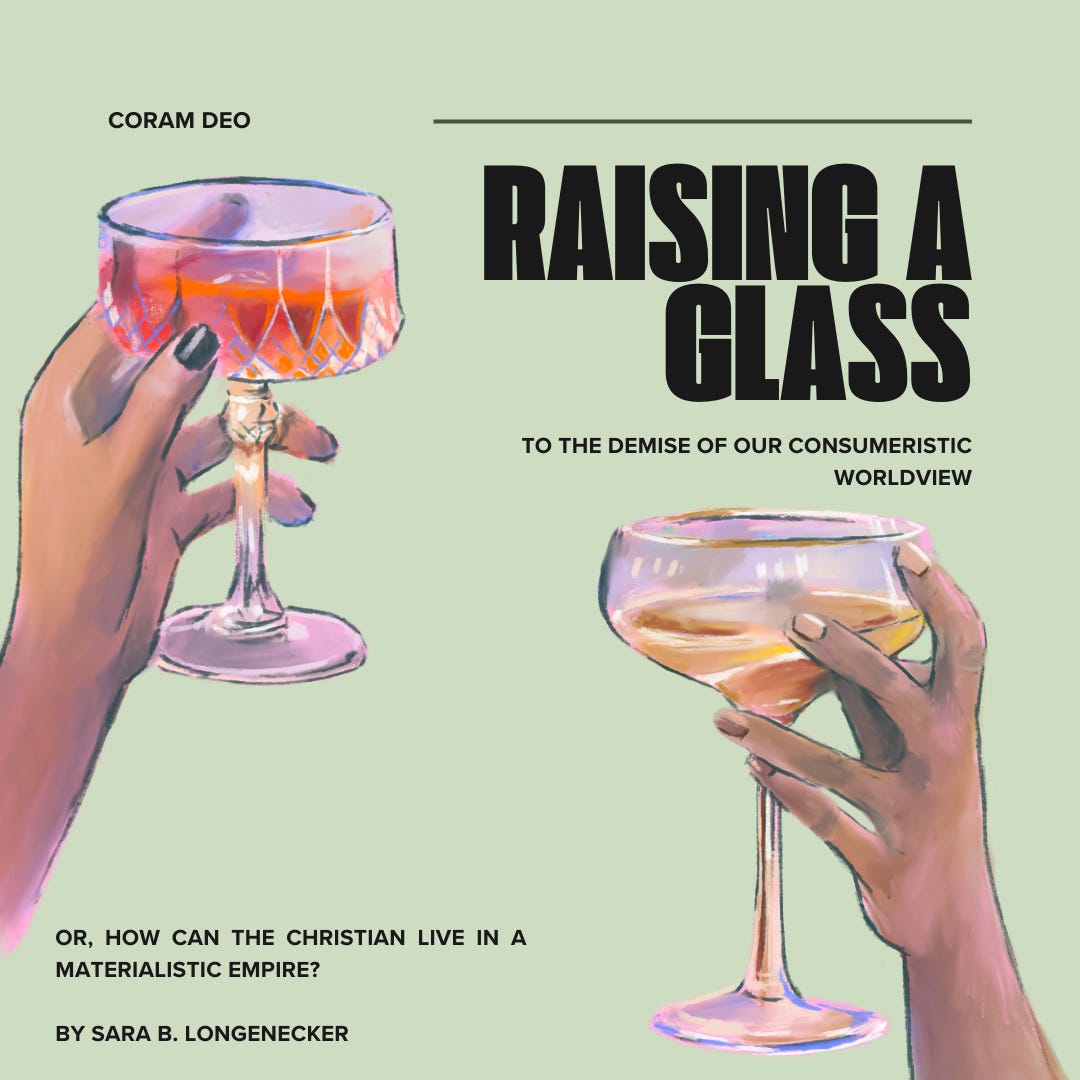
Friends, let us lift our glasses and toast to the undoing of our consumer-crazed hearts. We will choose, instead, to slow down and let every instinct to satisfy ourselves be put to rest. We will resolve to wait on His word, to look for signs of His salvation, and allow a holy curiosity to stir within us. We will turn our longing toward the Master who gives of Himself, poured out and ready to quench every thirst. And when we drink of this cup, we "will never be thirsty again." [2]
Cheers!
Quick end note: Some of you know that I work in pro-life advocacy, and this continues to be a tenuous moment for our work. If you are interested, I have an op-ed at Lucid Media that just went live. Let me know what you think!