


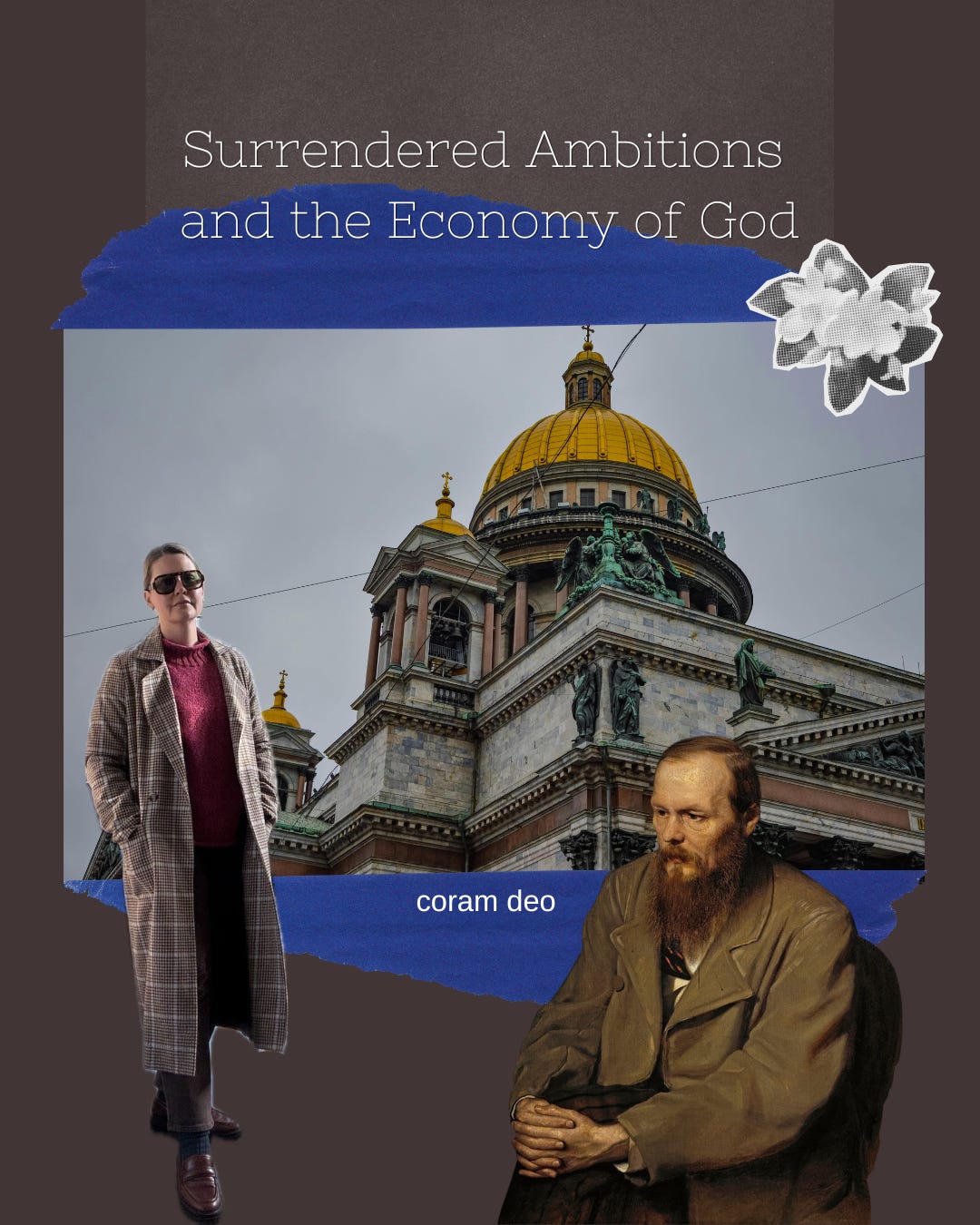
It took me four months to read Crime and Punishment, which, of course, I’m not proud of, though I did finish it with the help of Audible during my daily commute.1 In my defense, for whatever inane reason, I chose to start this book right as I was beginning a new job. Not just any job, but one some might call a “dream opportunity,” and one that required me to be in the office five days a week (long days bookended by a 40-55 min commute). No complaints necessarily, just setting the bleak, cold, Russian-like tundra of a scene for your reading amusement (sarcasm).
The book has a daunting reputation, which I felt acutely, but my desire to read and understand Dostoyevsky eventually overcame the general mind-bend, and I bought a copy. Two, actually. I bought two copies, which I didn’t realize until months later, when I finished the book and went to re-shelve the cracked-spine Penguin Classics paperback and saw an identical, pristine copy already there. Huh. Okay, so the task was done. I conquered the scary Russian, and now he rests silently beside other old passkeys to other old worlds. His world, Dostoyevsky’s world, I am still simmering over, though I think I understand it more now that a little time has passed. Some stories are like a hard rain on the cold winter ground; they need time and space to seep in slowly and go deep, all the way to the roots.
Intermission: I have just finished a short run at a job that triggers complicated feelings. I’m probably not ready to process it, but I am a writer, and when the words are ready, I’ve learned to let it flow. (Still, this is difficult.) My writing brain has been logged off for six months. I’m trying to reboot, but everything I say here isn’t right, too thin, too heavy, cringe. Bear with me.
With the recent turn in my career, I thought that I knew the unfolding of circumstances was ordered by God. I was called into a new realm and at a new level. I answered and experienced this thing, this great opportunity, but then it was costly–it cost me things I eventually couldn’t keep paying. A character in a book would move seamlessly into a new season without the cost, but a person in real life has layers of things she brings with her, and some things do not work within the new context. It’s complicated because many of these things were good, are good, and are people that I love the most, and they’re priorities in my life. So it felt like I was constantly having to choose between what was most demanding and what was actually important to me. Competing priorities–of myself, and of the opportunity.
Not to sound self-important, but I have been given so many amazing opportunities to do and experience things that most people would find unfamiliar, and I am grateful for each one. They color the days and shape the years into a tapestry of varied experience. But when the opportunity or job comes to an end (because very little in my life, aside from our family and the steadfast love of God, continues in perpetuity), there are big emotions, sometimes painful ones. Experiences that feel akin to failure. I have written about the “f word” before because the theme tries to rear its ugly head often; I don’t want to associate with that word. Someone who loves me very much insists that I rephrase; instead of “failure,” I will say “learnings.” As in, I’ve not failed at this job, I’ve learned more about what I want to do and what I don’t want to do. Instead of, “Well, that was a total waste of time and a failed experiment,” it becomes, “What kinds of learnings can I take away from this experience?” Anyways, I am moving through another one of these “learning” seasons.
There is a quality about Dostoyevsky’s main character that makes me wonder about the author himself, about what kind of inner demons he faced during his time, and how much of this particular protagonist was autobiographical. I found his character, the young and flailing academic Rodion Raskolnikov, to be irritating–his depression and grandiose self-absorption were so relentless that entering his world felt like being slowly dragged to the bottom of the Cumberland River. And yet, I needed to see what happened…I had to journey with him all the way to the end of the story.
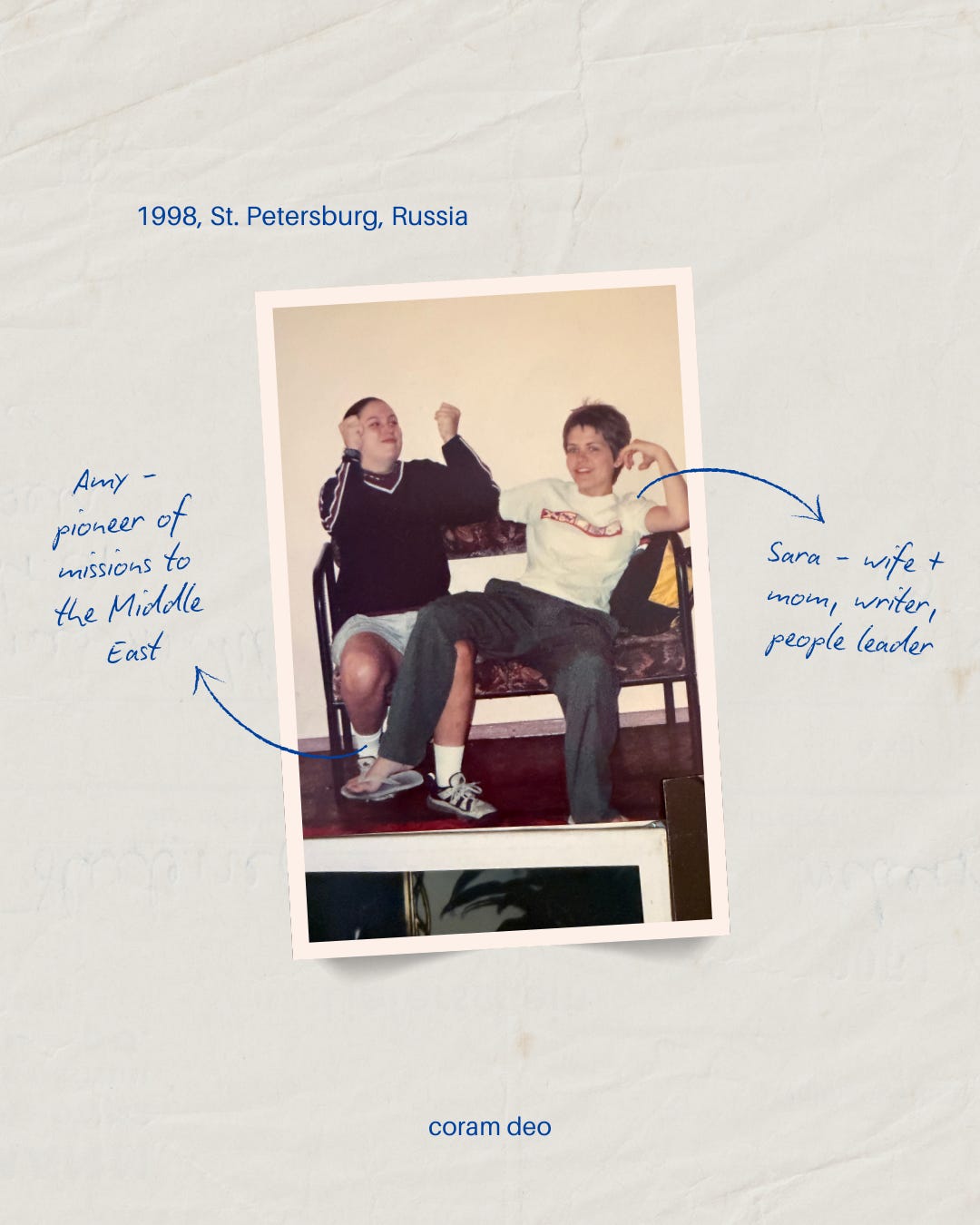
The novel is set in mid-nineteenth-century St. Petersburg (incidentally, the first foreign city that I traveled to and fell in love with at the age of fifteen), a tumultuous city both dreary and alive, crowded with industrial smog and horses and the pressing masses, and straining with the tension of the old ways being pushed aside in the name of progress. Raskolnikov lives hidden and isolated among the multitude, inwardly estranged from humanity by his delusional nihilism. For hours, sometimes days, he lies silent and starving, gradually becoming a prisoner of his own warped mind and the weight of his sin. The young man faces his future with a bleak outlook; his only hope of finding meaning in his unique life hangs in the air, like steam rising from the hot stone streets. Raskolnikov hungers for the thing that every man throughout history has sought, through various and bloody means: a purpose, a divine call, one that transcends and endures (even beyond our own short life). Like all timeless stories, Crime and Punishment feels like it could happen today, even now. If you have not read the novel yet, I won’t spoil it, but I will offer this tip: the beginning is wonderfully exciting, the middle is a slog (but important for developing the psychology of Raskolnikov and other characters), and the end will leave you mulling over it all for a good long while.
I know little about Dostoyevsky as a person; that is a research project for another time. What I do know comes through his storytelling. He lived during an era of great transition, when the Church and those who still sincerely called themselves Christian were becoming increasingly irrelevant in the face of modernity. Yet the deeper human impulse has not changed. His characters hunger for the kind of immortality that we see awarded to digital natives every day via YouTube, TikTok, and a riptide of internet fame. Raskolnikov’s temptation is nothing new–in the worlds we create online, we assume the divine role, imagining we can transcend natural laws because we see ourselves as special, unique, and evolved. The old world is always dying, and the new horizon always promises more than it can deliver.
In his classic work, My Utmost for His Highest, Oswald Chambers writes extensively about calling and, in his uncompromising and pastoral way, confronts our obsession with little-gods psychology. In the devotional essay, “The Vocation of the Natural Life,” he draws a distinction between God’s calling of the believer (to Christ, His Son) and our natural abilities that we may offer in service to this greater call.2 I find this counter to our era’s thinking (even among church circles) and so helpful.
Chambers draws from Paul’s writing to the Galatians, “But when it pleased God…to reveal His Son in me that I might preach Him among the Gentiles…” (1:15-16, italics added). The importance here is the right sequence of calling, and Paul writes it out as such (as in most things, God is extremely concerned with the order of creation because everything has been intentionally designed for His glory and our good). God called Paul to recognize and submit to His Son as Lord, and this is of the highest order. Then, Paul offered his natural abilities back to Christ in service by preaching to the Gentiles. The call did not emphasize the action (or burden) of preaching per se, but rather its primary purpose: to put Paul in right relationship with God, which freed him to respond in humble service (through preaching, traveling, pastoring, writing, etc.)
Chambers says,
Service is the overflow of superabounding devotion…God gets me into a relationship with Himself whereby I understand His call, then I do things out of sheer love for Him on my own account. The Son of God reveals Himself in me, and I serve Him in the ordinary way of life out of devotion to Him.3
And it’s one of those paradoxes of the Christian life; that when we respond to Christ and call Him Lord, our obedience unlocks a new kind of freedom to lose ourselves in Him. We don’t have to strive by the world’s ways of distinguishing ourselves in society…we are no longer bound to the systems and metrics of tiny-thinking humans who try to measure the depth of an individual person and quantify him/her for small ends. The trap of Raskolnikov’s worldview still remains; the actual world is too vast and chaotic, so we create our own artificial ones and become little faux-christs who moan and complain about having to die every day in our self-made realities. Even among the churches, “the calling” becomes a black hole burden when it turns inward.
In a climactic scene of the novel, our man Raskolnikov carries the yoke of his sin, that “crushing weight…from the hopeless despair and anxiety of all this recent time,” out into public, where it becomes physically visible in him.4 Something finally breaks inside of him, and the people nearby witness the moment and respond with mocking shouts as he drops to his knees in the center of the city. “He kneeled in the middle of the square, bowed down to the earth and kissed that dirty earth, with pleasure and happiness. He got up and bowed down a second time.”5 Raskolnikov’s internal compass is being shattered and refashioned; the scales fall from his eyes to the dirt. In relinquishing the illusion of control over his life and the nightmare of his own making, his vision opens wide, and hope enters like a bright, harsh winter light, washing away despair and making his heart clean and alive.
I don’t pretend to understand everything about this story, or about the contemporary search for meaning in our technocratic twenty-first-century world, but I am learning to read Dostoyevsky’s literary language for truth that I can take with me. (Quick note: If you’d like a more in-depth analysis of Dostoyevsky’s work and the topic of nihilism, please check out my friend and the most excellent Dr. Chris Palmer’s short course here.)
At the very least, Dostoyevsky exposes and diminishes the power of an encroaching nihilistic worldview, both in his generation and in ours, one that entices with a counterfeit freedom of rejecting the natural order God established in the beginning. His characters can’t bear the weight of their own broken moral compasses, much less the suffering of others, because that is how we are. We all face our own inner Napoleons. We are shamefully limited, and yet, we long for the glory of something truly great. Like children who attempt to run away, and after a time of hunger and cold and lonely hours, we begin to see that our freedom is found in answering the call back to the Father’s house. By coming under His reign and rule, we inherit the abundance of true happiness, peace, joy, and the fullness of His Spirit offered for us. From this vantage point, even the dirty earth becomes blessed.
“Sometimes saying yes to a call means saying no to something else.”6 These words could not have cut deeper into my heart, because their truth has rung through my recent weeks and months. Where my vision has become too narrow and small, I sense the Holy Spirit asking me to relinquish more (all of it, actually) in the name of freedom. To welcome God’s economy as something totally different from what we can see in the natural (bigger, more expansive, infinitely more creative) and giving purpose even to those experiences that we don’t understand. Saying yes to the calling of God is so much higher and deeper than the vocation we offer to Him in service because the continual yes is to Him, Christ, the person of God. And in Him nothing is wasted, and everything is beautiful.
Until next time,
SBL
Not a sponsored post, but wouldn’t what be fun, Audible? Also, I’m referencing the Penguin Classics translation first published in 1991 and revised in 2003.
Oswald Chambers, “The Vocation of the Natural Life,” My Utmost for His Highest, January 17.
Ibid.
Fyodor Dostoyevsky, Crime and Punishment, p 626.
Ibid.
Thank you for writing this tiny and important book, KSP! Karen Swallow Prior, You Have A Calling: Finding Your Vocation in the True, Good, & Beautiful, p 78.
Welcome back, Sara, and thank you for this excellent post. I've been spending some time in this Russian world as well while writing a review of an album of Russian piano music. I'm also past halfway through reading Anna Karenina at the moment. Heavy-duty stuff!