


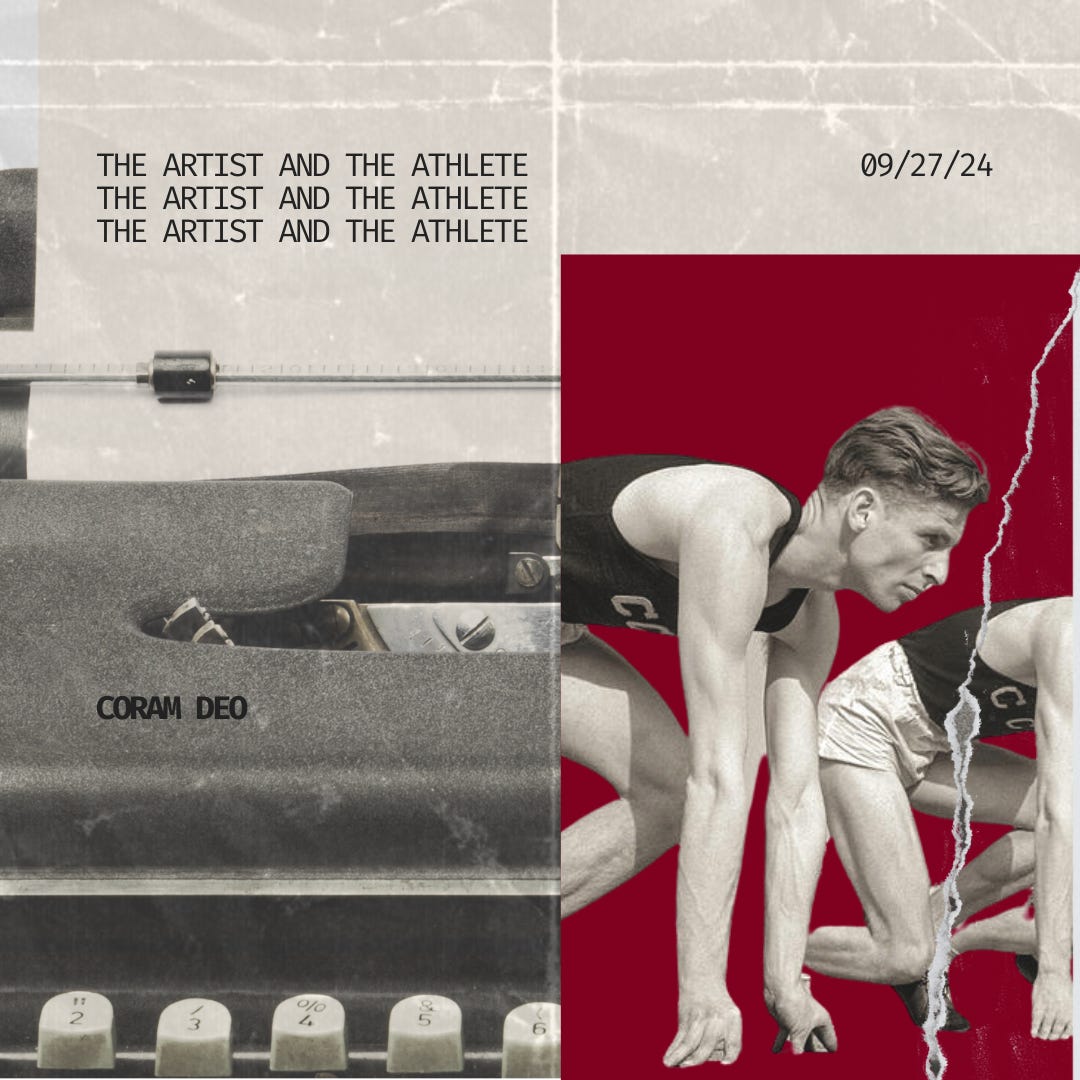
When you think of the archetypical artist, what comes to mind? I envision a man in his late 50s or early 60s, with longish hair around his ears and neck, possibly a dark mustache or goatee. He would be dressed in a workman’s jacket smeared with various shades of blues, greys, and whites, slouching low in an old chair (the kind you would find at your grandma's house or an antique shop), holding a cigarette lightly between his fingers, which are dotted with large metallic rings, and gazing off into the distance with a look of anxious despair on his face.
What about the archetypical athlete? He is young, in the prime of his physical life. His body is sleek and strong, his skin is a light bronze, and his clothing is purely functional. His eyes are fixed on one thing and one thing only: to win. He lives at the gym, the track, the juice bar. He is an Olympic runner, and he is the picture of ambition, vitality, and speed.
The artist and the athlete are brothers, but they are not the same.
The artist and the athlete rely on a set of particular technical skills and repetitive practice to improve in their respective fields. They pursue their vocational callings with intense passion in ways that sometimes must feel all-consuming–eating and sleeping whatever current project or goal they have before them. Both vocations demand great dedication and perseverance. Both the artist and the athlete have the potential to impact their generation, as well as future ones, with their contributions to society and culture.
While the athlete's skill relies primarily on the physical expression of strength, speed, agility and endurance (mainly as expressed in the critical moment of competition), the artist's skill is inherently intellectual and creative. The artist may use a variety of modes for expressing the artistic vision, be it through music, painting, sculpture, language, or design, but the physicality of his work is unto a greater purpose. He doesn’t spend hours and days and weeks and months, and sometime years, working on a piece just for the sheer aesthetics; he is an artist. Therefore he communicates meaning. The artist seeks to express something deeper—some idea or insight, or something emotional, or even spiritual.
It is probably true that the greats–in both the arts and athletics–accomplish what they do because of a disciplined regime of showing up, doing the work, getting better, and not giving up. But honestly, I don’t often relate to the athlete. I avoid waking up early, for one thing. I’m not motivated to abide by the strict rules of a game. I hate the taste of Gatorade, and I’m not great at keeping up an exercise routine for very long. I can get a little competitive when I’m watching my kid’s soccer games, but that’s just a mama’s pride, right?
I am much more at home in an artist’s world, fueled by my passions and the creative cycle, where work happens (maybe, hopefully) as inspiration hits. I’m not endorsing this way of working; I’m merely saying this is what comes naturally for the creative soul. While the athlete keeps a strict training schedule, receives metric-driven coaching, and is ever pushing toward his goal, the artist, on the other hand, is often creating alone (at all hours of the day or night), pouring his heart and soul into his work, and is perhaps sensitive to critique. It doesn’t help that he is often on edge from too much coffee or…other stimulants.
The athlete has an essential place in culture, demonstrating the amazing capabilities the human body contains and inspiring his fellow man to achieve greater things. This is the virtue of athletics, so to speak, the athlete’s purpose in embodying physical greatness.
Even so, the artist must not be confused or conformed to become the athlete. In the most basic terms, the athlete expresses through action and performance in competition, while an artist expresses through creation. Success for the competitive swimmer or baseball player is objectively measured by scores, times, or outcomes. Conversely, the artist lives and breathes the subjective experience through song, poem, or the like, which extends the open invitation of interpretation.
The means of the artmaker matter, of course–how an artist expresses their message through the beauty and quality and skill of their art is wonderfully important. But perfection in aesthetics that serves a shallow and disorientating goal of communicating evil as good, or worse, nothing at all, will ultimately create a society of starved and numbed people. Performance without transcendental meaning completely strips the artist of their God-breathed potency.
Artmaking must reclaim its prophetic purpose; for the Christian, this is a good thing.
I believe we, as the catholic/universal Christian Church, are in a pivotal moment when it comes to the arts. The West has learned the formulas, we’ve commodified the creatives, and we are suffering from a lack of meaning. We are good at growing creative brands but terrible at spiritual formation for the artist. We know how to turn out the crowds, but the people go home hungry. What if the artists bypassed the byproducts and, instead, began to earnestly eat and drink of Christ? To develop a highly discerning palette for what is actually beautiful, true, and good?
What if we learned to spread an everlasting feast?
Until next time,
SBL
This is a very interesting topic for me. I could approach this topic in so many different ways. I was the captain of the team in all 3 sports I played in high school and I also wrote poetry and won an oil painting contest held by a local community college my senior year. Even now, I’m a firefighter which is a very left-sided brain world to be apart of so I’ve lived my life commuting from one world to the next.
I will say, I find the top of the top athletes at any level almost always have a certain reserve to them meanwhile there’s a deep fire in their bones that artist can definitely relate to. Athletes are like physical philosophers to me.
"Performance without transcendental meaning completely strips the artist of their God-breathed potency."
I believe this is a foundational element for why a lot of worship music has lost power. We found things in the past that resonated with people and now seek to perform them well. We have more professional performers than ever before, but we live in the past and lose meaning and potency.
Regarding process, us creatives can tend to live by our feelings more than others - waiting for inspiration to hit before we take action. If there's anything I've learned from the greats, it's that you can't always wait for the inspiration to hit. You have to seek it out. There is value to regimen and simply pushing through the lack of desire to work to seek out inspiration. It's like luck: you can't force it to happen but you can put yourself in better positions for something good to happen to you. I'm preaching to myself here.