


“See every little flower straighten its stalk, lift up its neck, and with outstretched head stand expectant: something more than the sun, greater than the light, is coming, is coming–none the less surely coming that it is long upon the road!”
–George MacDonald, Lilith, Ch. XLV ‘The Journey Home’
It’s a Tuesday morning in early September. 8:02 am, about 58 degrees, and the leaves are finally turning. Squirrel thrash around in the trees, making noise and plans bigger than they warrant. The grass sparkles with dew, as fine as silk. Various plants on my porch hang on awhile longer, but they bear the marks of boy violence–branches reaching out for more sunlight, broken off too short, probably from too-close bike rides and little wandering fingers.
A discordant choir makes unceasing birdsong, and I watch as the gray barn kitty parades past the kitchen door with a chipmunk hanging limp in her jaw, its soft red fur soaking up the morning light. The dogs are insanely jealous.
It’s funny how my mind will tune out the sounds of morning traffic from the road when I am thinking on other things; momentarily, I enjoy a kind of country silence (not quite, of course, because of a cacophony of surrounding life), only for it to come droning back like I’m being pulled out of a dream. At times, I long to be somewhere even more remote–no sounds of trucks at all. Somewhere beyond what I know to be quiet and still and yet alive. Only the wind and rustle of tree branches, or waves, or whispering grasses, or nothing but the morning sun on my face and peace enveloping all.
As spooky season approaches, I find myself drawn once again to the captivating allure of Victorian-gothic tales. It was around this time last year that I delved into Oscar Wilde’s The Picture of Dorian Gray for the first time, and shared my brief yet mixed review. In the previous October, I was introduced to Mary Shelley’s Frankenstein, a reading experience that truly changed my life.
Nineteenth- and early Twentieth-century classic fiction is easily my favorite kind of reading. There is something about this era of fiction that awakens my mind and soul like nothing else, and this is especially true as the world around me slowly decays into a warm sunset. When autumn arrives in my area of the South, I tend to reach for stories that take me to another world and sort of bend the veil to reveal another realm. When we, as supplicant readers, are drawn into a fantastical and fictional world found only in the pages of a book, we participate in a kind of travel via the road of imagination. You and I take a real risk when beginning a new story. We open the pages as we open a door and face whatever creature, adventure, or moral dilemma may come our way. As Bilbo warned his young protege,
“It's a dangerous business, Frodo, going out your door. You step onto the road, and if you don't keep your feet, there's no knowing where you might be swept off to.”
The same can be said of a George MacDonald fantasy; the world of his making is entirely more real, more fixed in reality than our own. I first encountered MacDonald, as many people do, in C.S. Lewis's The Great Divorce, where he introduces MacDonald in the narrative as “a very tall man, almost a giant, with a flowing beard…here was an enthroned and shining god, whose ageless spirit weighed upon mine like a burden of solid gold.”
MacDonald’s influence on Lewis (and a roster of other literary figures of the 19th and 20th centuries) was such that Lewis depicted him as a giant of a man. Throughout his life, MacDonald enjoyed a long career of authoring novels, fantasy, poetry, sermons, literary criticism, and other writings, but it was his fantasy and fairy tales that established his giant-like, legendary status. If you are not yet familiar with MacDonald’s works, I strongly encourage you to begin with The Princess and the Goblin (and its sequel, The Princess and Curdie).
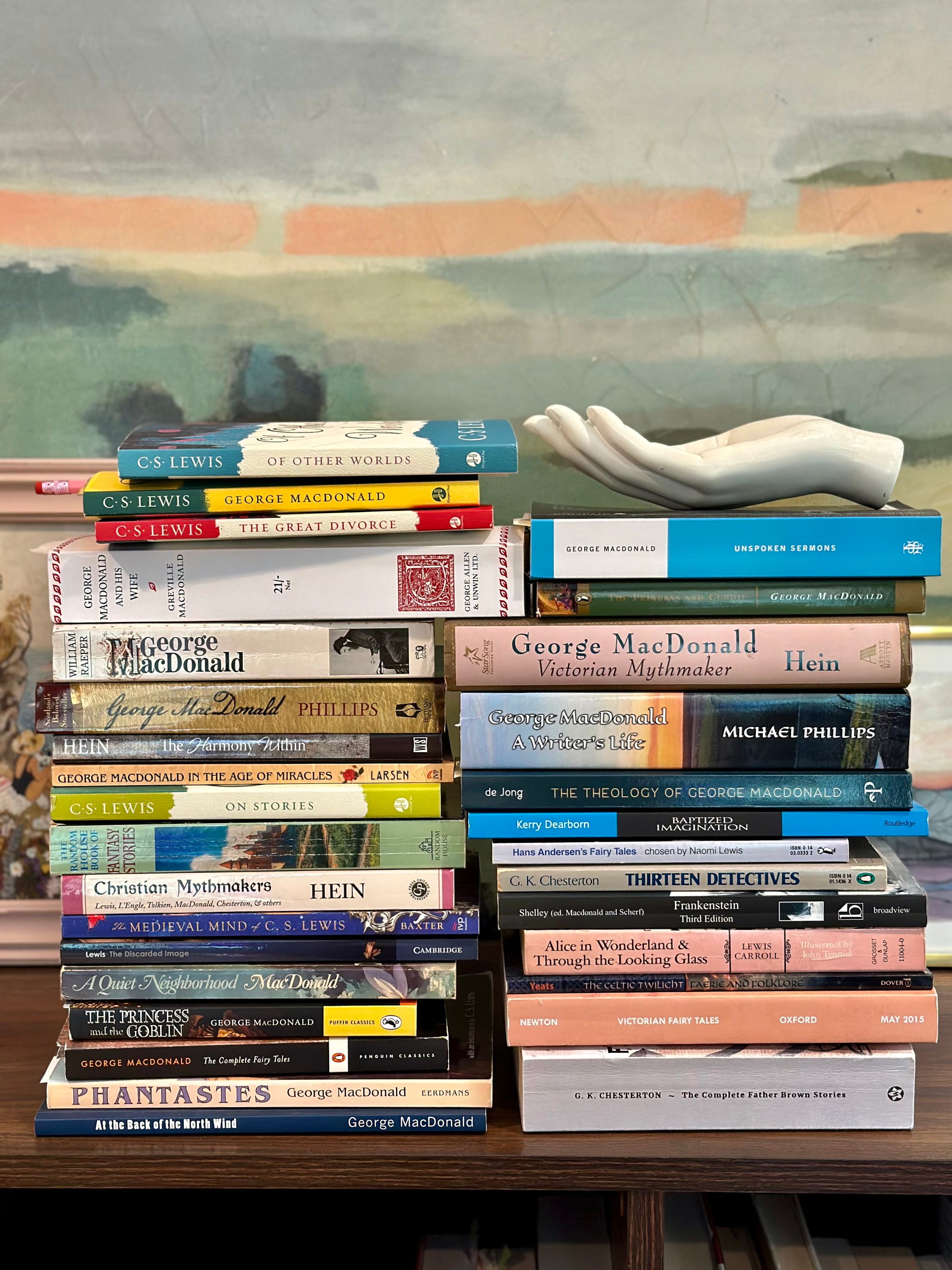
This autumn, I am reading MacDonald’s Lilith, first published in 1895. Lilith was the last fantasy work he penned, written late in life, and widely considered one of his best (if not the best of the genre). The story opens with Mr. Vane, a bachelor and recent graduate, who lives in an old Manor house inherited from his deceased parents. Mr. Vane spends most of his time in the house’s large library, perusing books on science and philosophy, until one evening when he catches a glimpse of what might be a ghostly visitor to his library. The apparition makes another appearance in the library, this time as a slender old man in a long, dark coat, ‘shiny as from much wear,’ and this second visit is enough to spark Mr. Vane’s curiosity. He asks the servants of the house if they know of any haunting history and learns of a legend concerning Mr. Raven, the long-time librarian to his ancestors.
Upon a third shadowy visit from this Mr. Raven, Mr. Vane follows the old man out of the library and down a series of hallways, up a flight of narrowing stairs, and finally into an unknown room hidden high in the rafters of the house. Mr. Raven is nowhere to be seen, but as Mr. Vane’s eyes adjust to the dim light, he notices a particularly tall, antique mirror made of an ebony frame and dusty glass. Or was it a frame protecting a picture of ‘a wild country’ of hills, moorland, and mountains? Stepping closer to inspect the image, Mr. Vane finds himself falling inside the frame of the mirror and translated to another world. He immediately encounters Mr. Raven as his raven-self, talking bird and man alike, and guide to the wise. But, alas, our protagonist is not wise. Mr. Vane must learn to heed the voice of wisdom over the days and nights to come of his perilous Dantean journey.
Lilith is a classic example of the mind-bending, fever-dream genre of fantasy literature, the likes of which inspired MacDonald’s friend and colleague Lewis Carrol to write the Alice in Wonderland stories (or, Through the Looking Glass) and, later, Lewis and Tolkien’s epic fantasy world-building. The story follows Mr. Vane’s expedition through a mirror-portal to the other realm, where he travels through a world of craggy mountains, dark valleys and caves, desolate deserts, and hot-water rivers, guided by a series of personified moons.
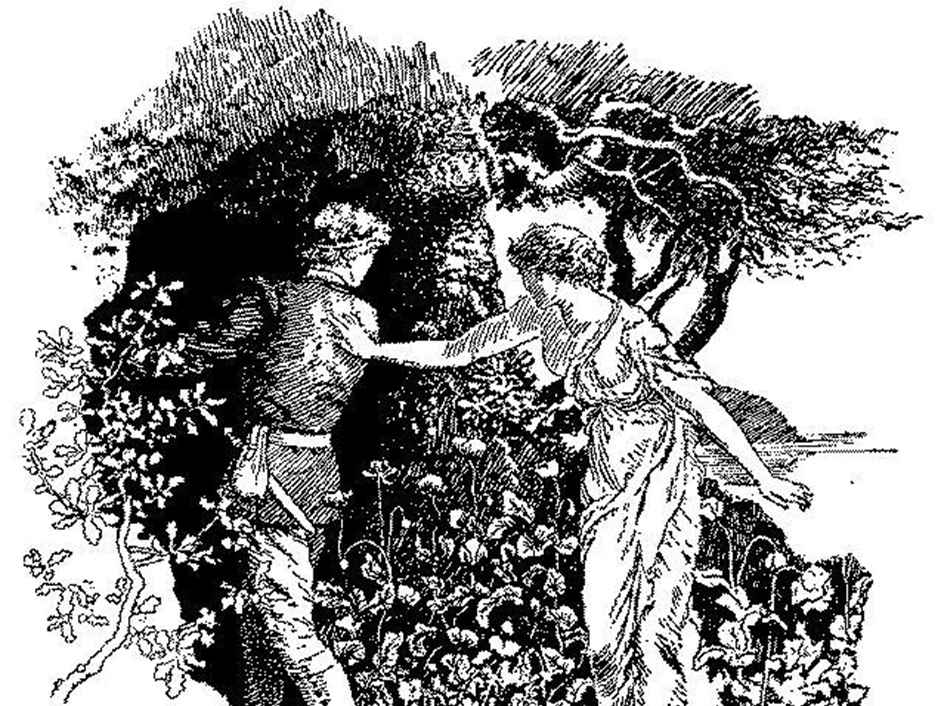
While traveling, Mr. Vane encounters a full roster of characters–Mr. Raven, also known as Adam (the first man) and his angelic wife, Eve, also known as Mother; all manner of vile beasts and creatures that rise in the night; still clothed skeletal ghosts of persons awaiting their eternal fate; a large group of Little Ones, or wild and sweet children of various ages, who live in the forest and are cared for by Lona, the eldest and maternal leader of the youth clan; a village of dumb ogres, who we learn is the result of rebellious children “growing” into ignorance and brutality; Mara, a shrouded woman who lives in the House of Bitterness; and a city of childless Mothers and Fathers, who live in fearful servitude to the story’s villain–Lilith, the first wife of Adam, and vampire queen of the damned. Oh, and as if those weren’t enough to keep straight, there are two leopards, one with dark spots and the other a gleaming white, fighting viciously for dominance throughout the odyssey.
While the large cast of characters and ever-changing scenery are challenging to follow at times, the difficulty only adds to the disorientating nature of this otherworldly realm. MacDonald expertly weaves in themes that will have you pondering their meaning days after reading: themes of spiritual sleeping and awakening, old man vs. new man (Adam vs. Christ, Lilith vs. Eve), dying to Self/death unto Life, revelation and renewal, the Spirit of God as a person and as a regenerating force, childlike faith vs. brutal materialism/skepticism, maternal/sacrificial love vs. pride of life, the coming eschatological era and final reign of God, and much more. MacDonald infuses a lifetime of spiritual revelation in this complex and captivating allegorical tale, and we get the sense that some of Mr. Vane’s trials and triumphs were birthed by MacDonald’s own experience with the mysterious ways of God. Ultimately, it is not only MacDonald’s deep understanding of the high cost of salvation but his ever-expansive eschatological vision of God’s coming and ultimate reign that drives the narrative to its gut-wrenching climax (no spoilers here, promise!)
It’s not a perfect book, by any means, but it is profoundly unsettling in the very best way. MacDonald’s magic is found in the images and feelings he creates and how they capture our imagination precisely because they reference something deeper, truer, and more eternal than what we typically encounter when we step through the glass and into a new story. If you are new to fantasy, it’s okay to feel a moment of hesitation–do I dare take the risk of going through to the other side? Likewise, when Mr. Vane questions his own enterprise, Mr. Raven answers,
“I tell you, there are more worlds, and more doors to them, than you will think of in many years!...But if you understood any world besides your own, you would understand your own much better.”
Have you read Lilith? What did you think? Do you have any favorite fantasy or fairy tales to recommend?
Until next time,
SBL
Beautiful post - I think this was just the intro I needed to finally read Lilith. I've read Phantastes, but this sounds even more "out there." That's an amazing stack you have there, and I'm intrigued by the biography written by his son as well!