


Time is a funny thing. I’ve put off writing this essay for three, maybe four weeks. I’ve wanted to write, and I’ve written words, but nothing has stuck to the wall. No thread emerged. And of course, as more time passed and nothing was written, the nagging shrew of guilt began to taunt, “you’re not a real writer,” “you might as well give it up,” “you have nothing to say.” And the last one might have had a bit of truth in it: every time I put words down on the page, there was a whole lot of nothing to them. Until today, for whatever reason.
Sometimes it seems we just need time to not do the creative work.
Photographer (and author) Sally Mann says,
I’d go so far as to say that even when you stop working altogether, for long stretches, there is ultimate good in it for your creative work, whatever it is. Inactivity isn’t failure; like an athlete, your artistic muscles need time for recovery; repose is restorative. Paradoxically, not making art can teach you as much as making it, and if nothing else, it fills the reservoir of desire.1
At 75, the woman knows something about living a creatively productive life. I will take her consoling words to heart, because she has produced some of the most arresting images I’ve ever seen, all while being married, raising three children, and generally keeping a homestead. But this isn’t really her idea, nor does it belong to the Romantic poets or the Renaissance artists. They borrowed from the One who designed our makeup and knows the best rhythm for a beautiful human life. Jesus also rested, pulling away from busyness and spending time with his friends.
The apostles returned to Jesus and told him all that they had done and taught. And he said to them, “Come away by yourselves to a desolate place and rest a while.” For many were coming and going, and they had no leisure even to eat. And they went away in the boat to a desolate place by themselves. (Mark 6:30-32)
The disciples had just come back from being sent out to preach and heal, and the crowds were so thick that nobody even had time to eat, yet his answer was to get them in a boat and go somewhere quiet. It’s tempting to picture the twelve as a supporting cast Jesus collected for the job, but you can’t spend almost every day with the same men for three years without growing close to them, and that closeness had to come from somewhere. Yes, it was the work of the Holy Spirit among them, calling them deeper into the kingdom and sometimes calling them away for moments like this one. Rest was part of how Jesus paced himself, and quality time with his people was part of the rest. Their repose was restorative.
I’ve realized this is one of my major motivators for homeschooling and for my own choice of work: I want a pace of life for our family that allows for what I call ‘space,’ or time for true leisure. We all need restoration to ultimately be productive and creative; this is inherently human. We are cyclical creatures. We need time to rest, to think, to engage in activities for their own pleasure, and to be together with the people we love without an agenda.
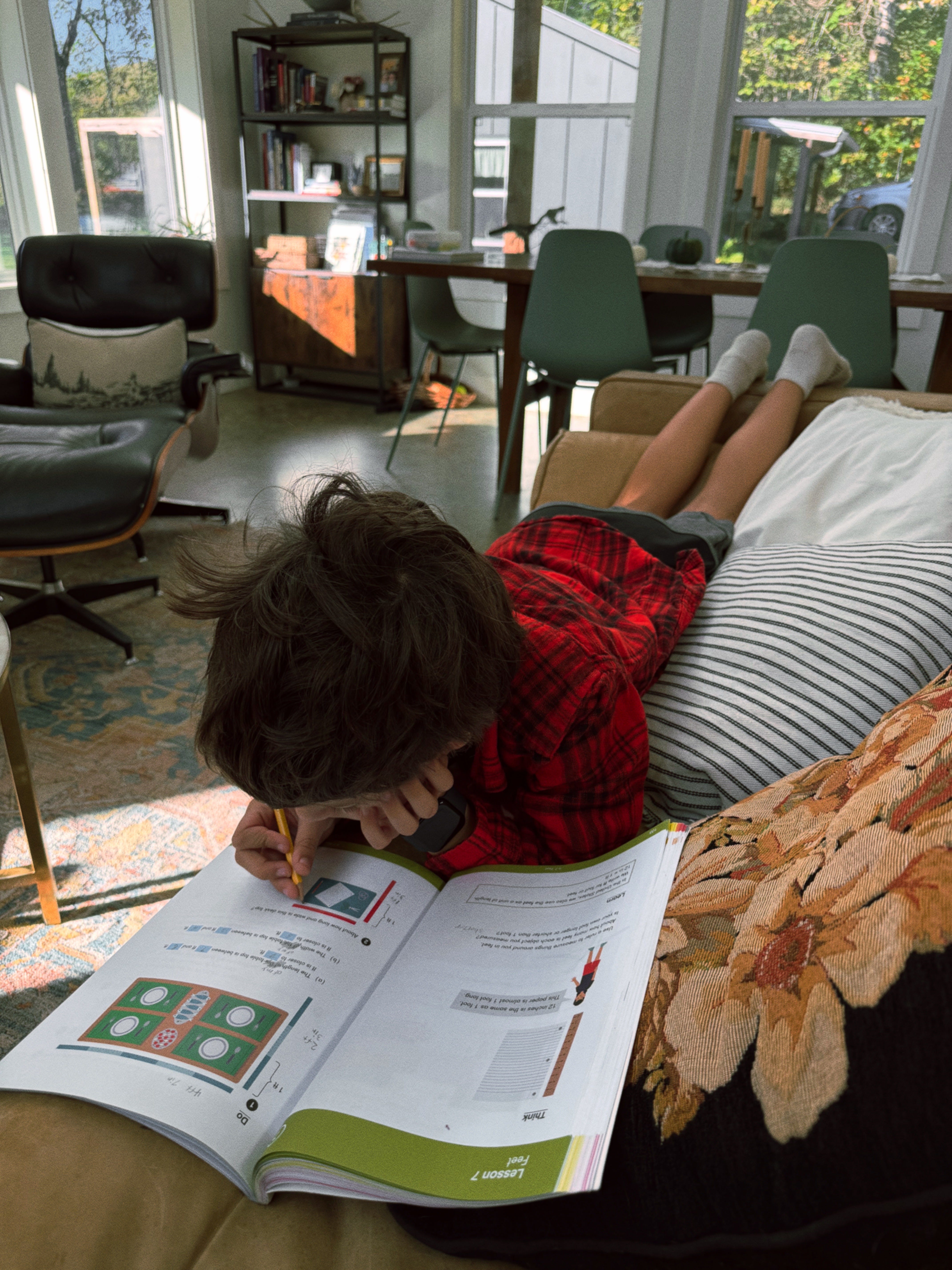
If you couldn’t already tell, we are educational experimenters around here. We have three sons, currently ages 14 (9th grade), 13 (7th grade), and 9 (3rd grade). Our family priorities have always been to love and honor God, diligently seek and walk out our callings before Him, and love and care for each other. A big part of each of us seeking and finding our individual (and corporate) calling comes from our family culture: encouraging one another to stoke curiosity, remain humble, and be ‘forever learners.’ This morning, for example, one of our boys chatted with my husband about simple machines and levers, which led Michael to give the rest of us a quick demonstration of how a piano key moves an internal system of levers that moves the hammer to strike the string (and make a sound!).
[As an aside, I think one of the best pieces of marriage advice I can give is to marry someone who is keenly interested: interested in life, in their own personal growth, and, obviously, in you! 😉 An interested person will never be boring.]
I’ve also stayed involved in work beyond homemaking, doing every iteration of it from full-time in-office to full-time remote (with travel) to part-time hybrid (3 days a week in office) to now part-time remote (with office time optional). Whew, that sentence makes me tired. The juggle is constant, so I’ve leaned on technology as my own ‘support staff.’
My philosophy on AI is simply to optimize what is already process-driven, and what is not benefited by my personal touch (or aids my personal growth), so that whatever time is freed up goes to the transcendental things in life: time with family, reading quality literature, being outdoors, generally embracing a classical, Charlotte Mason style rhythm of life. I haven’t (and likely won’t) take a hard stance against AI because I don’t view it as an existential threat. It’s artificial by name; it cannot be real real, because reality is based on consciousness, which finds its origin in God. The “trick” of artificial intelligence is simply pattern recognition, which I will use to my benefit without a qualm (and you do too, if you use spell check!). Our life is full, and I have a lot of responsibility; I will take any help I can get. I’m chronically distracted by whatever sparks my curiosity at the moment, so sometimes I need help deciding what is mine to do today and what will have the most impact. I use this tool every day.

With this philosophy in mind, we’ve returned to homeschooling (or, a version of it) this academic year. This will be our third attempt, but who’s counting? We’ve enrolled them in a classical tutorial; they’re in person two days a week in a classroom setting and at home with us the rest of the week. I really love this schedule, and I think our boys appreciate having more time at home. The classical aspect has always been important to me. At the tutorial, students are served a feast of information and formational experiences to indulge in… a typical day might find them reciting the Nicene Creed at chapel, learning to read sheet music, discussing the Iliad as a class, playing soccer in an open, grassy field, gathering in math cohorts according to proficiency (and not grade), and replicating the Mona Lisa with acrylic paints. I’m thankful we have made this change as a family; it’s already bearing good fruit.
But please don’t think I’ve got this whole thing figured out. We live by iteration over here. If I’ve learned anything in my 40+ years, its to keep trying versions of something until it works. This version of school, paired with my flexible/remote work situation, is working for now (I definitely couldn’t say that a year ago!) So we keep going, we pay attention, and we make small changes as needed. Life’s lack of permanency is both heartbreaking and beautiful, isn’t it?
Recently, Spencer Klavan wrote in response to a question about his own calling, sharing that he hopes to inspire people to spend their free time enjoying the liberal arts. I love this answer because it feels genuinely honest; inspiring someone to read Tolstoy may not seem as important as a calling (for example) to be an ER doctor, but I know my own life, in a way, has been saved by classic literature.
Klavan protests against a future made so completely uber-efficient by AI that we bypass the true expression of leisure, the freedom to spend time on restorative activities. He writes,
To steel yourself against this grim eventuality, it pays to ask who or what deserves the precious gift of your attention. I think Homer does. I think Dante does, and Manet, and Kurosawa and Kafka and Niels Bohr. Philosophy, art, literature, even mathematics at its noblest: these things reward our investment in them because they put us in touch with other souls, and with beauty. They’re worth doing even when you don’t have to do anything.
This gets to the heart of why I want this kind of education for my sons, and also (ironically enough), my use of AI tools: I want to be efficient with my time on the things that must get done and benefit from streamlined processes, so I can slow down and enjoy my time doing things that are beautiful and good.
I will listen to a non-fiction prescriptive audiobook while I’m zipping around town doing errands because I can get through this type of book (which generally only communicates one or two main ideas through many illustrations) quickly, and I can think about the topic while I’m driving. I would never listen to a classic work of literature this way; to me, that feels obscene. If I’m to enjoy Anna Karenina, I want to be curled up in cozy socks and sipping a mug of tea. I want to be transported to Russia for long stretches of time. I don’t want to rush it; I want to savor every word, for the pure pleasure of reading a great story.
I’m wondering, how are you being restored this month?
More October Things
Reading
George MacDonald’s The Portent, a Highland ghost story. Did you expect anything else of me??
Things That Are Good To Do. (You’ll never believe #4!! lol)
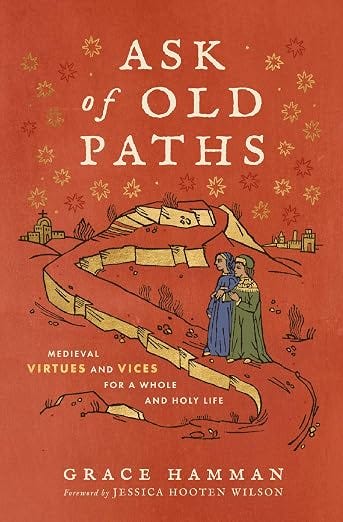
Grace Hamman’s lovely book, Ask of Old Paths: Medieval Virtues and Vices for a Whole and Holy Life. Grace was one of the first writers I discovered on this platform, and I’m so grateful for her research!
Listening
This recent pod episode with Arthur Brooks, How To Know What You’re Supposed to Do With Your Life
Can’t get enough of Stephen Wilson Jr.’s version of Stand By Me
Watching
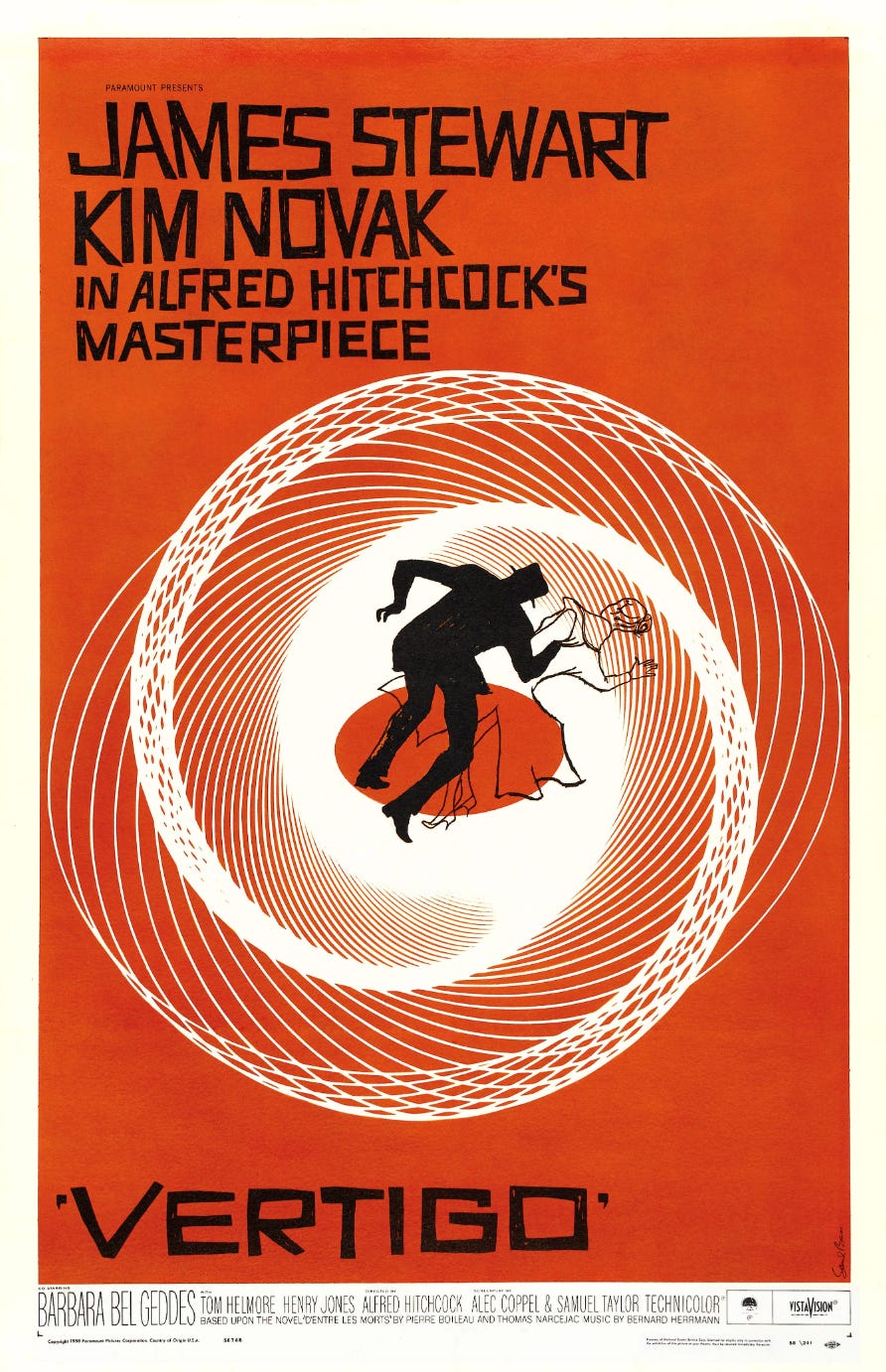
Anything Hitchcock, this time of year. But Vertigo still leads the pack for me because of how impossibly chic and (still) creepy it is.
I hope you are all finding some ‘space’ in your week to rest, listen, create, explore, and enjoy spending time with those you love. And I hope you get the good candy this weekend (a Reeses or two will find it’s way to my fridge soon enough!) 🎃
Until next time,
SBL
Sally Mann, Art Work: On the Creative Life, 92.