



Yesterday marked four weeks of my new exercise/movement routine, and I want to tell you something about it. Stick with me for a few moments; I promise this will not turn into a wellness/get healthy/resolutions newsletter.
In late 2023, I started myofascial/body fascia therapy to rehabilitate certain areas (jaw, neck, headache) where I was experiencing acute pain. After several sessions, I realized I needed to start incorporating regular full-body stretching and movement to reduce inflammation, maintain the progress gained from the therapy, and keep my fascia flexible and happy. So, in the spring of last year, I subscribed to a Pilates app and started moving/stretching on most days, and the pain subsided. I felt better, for sure, and I knew I was on the right track. But then life happened, as they say. Kids got sick, mom got sick. Dad traveled and then traveled again. Work started to pile up, and then the holidays hit like a tornado of activity. I lost any rhythm of intentional movement I had maintained, and now I felt depressed and defeated. Snowed under, as they say.
Then, on Christmas Eve, I’d had enough. I was sick of not moving. I convinced my family to join me on a long walk around a lake. The sun was shining and it wasn’t too cold and the ducks were obnoxious as usual (city ducks, you know). As we walked, I decided that I would not let the invisible blockers prevent me from doing what I knew I needed to do, what I wanted to do. I would solve this problem because I now had a vision of what my life could be like; I had tasted and seen that the other side was better.
Want to know what those blockers were? Get ready, because they are Deep and Profound.™
Two main blockers were preventing me from sticking with the routine. First, I was repulsed by exercise clothing. I hate how it looks, but more to the point, I hate how it feels…the suuuuper tight leggings and sports tops are miserable to get on and off. It was a dumb blocker, but was real enough to keep me from the movement.
The second and more significant blocker was that I believed a “real” workout had to happen first thing in the day, but I am not a morning person. I would love to be a morning person! But Jesus did not make me that way, and I have to trust his good design (lol). Every day I woke up and did not exercise in the morning, I felt like a failure. Not a good way to establish a new routine.
However, once the vision of my life with movement (and, more importantly, without pain in my jaw) became real, I knocked those blockers out like they were nothing. So what if I hated exercise clothes? I just bought a couple of pairs of sweatpants and wore whatever top I already had. The fact that I am not a morning person will probably not change at 41 years old, so I found a time slot that works for me–after I bring the boys home from school but before dinner. And as a fun bonus, two out of three of my sons often join me!
While it might seem early to talk about how this is working for me, I just gotta say…it is working for me. I’m enjoying the movement, for sure, and how I can feel my body getting stronger and more flexible, but more than that, I feel free from the gray clouds of resistance that I dealt with for so long. They were like hovering dementors sucking the life out of any motivation I had to feel better, telling me (shallow, vapid) lies to keep me in a kind of bondage.
But you know what defeats darkness every time? The light.
I first encountered George MacDonald, as many people do, as a character in C. S. Lewis’s novel, The Great Divorce. I was intrigued by the way the narrator described him as “a very tall man, almost a giant…an enthroned and shining god, whose ageless spirit weighed upon mine like a burden of solid gold: and yet, at the very same moment, here was an old weather-beaten man, one who might have been a shepherd…”1 The contrast was wonderful. Who was this man? Was he a metaphor for something? Was it Christ?
To my surprise, I learned that Lewis wrote the historical figure (his interpretation of) George MacDonald, his mentor, into his fictional story. The quote above aptly describes MacDonald as a person and especially captures the duality of who he was to Lewis–both a “shining god” and a “shepherd.” Lewis and MacDonald never met, but Lewis readily admits the great influence MacDonald had over his life and work: “I have never concealed the fact that I regarded him as my master; indeed I fancy I have never written a book in which I did not quote from him.”2 Perhaps then, it was inevitable that MacDonald-the-man would eventually find his way into one of Lewis’ stories.
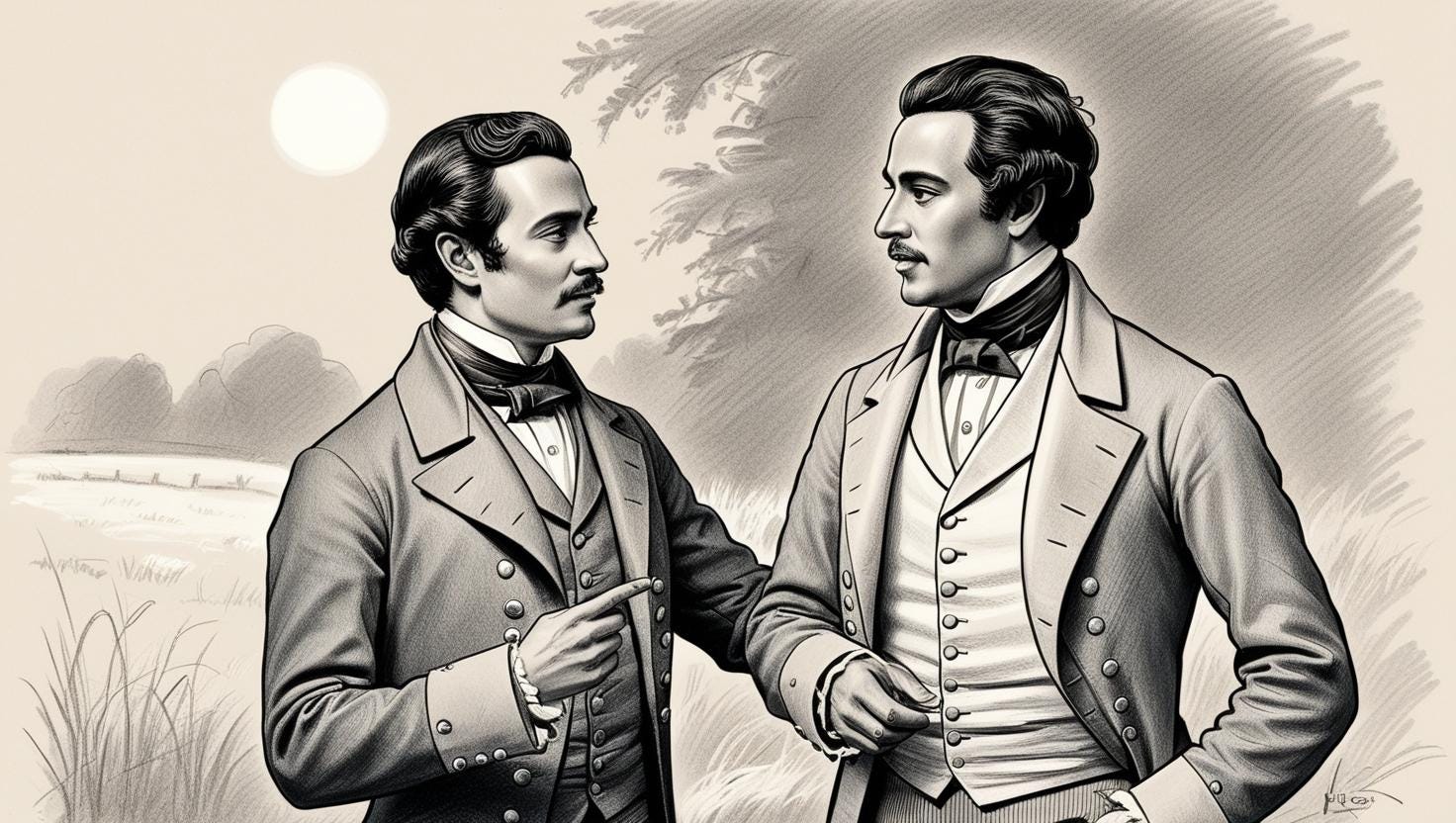
In The Great Divorce, Lewis gives the character of MacDonald the moniker of Teacher. I love that he chose this title in particular because he could have called him many (appropriate, deserving) things: Poet, Preacher, Pastor, Prophet, Mentor, Father. But I get the sense that, for Lewis, ‘Teacher’ kind of sums up all of the other titles. MacDonald, at heart, is a teacher, and in the wide variety of his written works, he expresses his gift of teaching by consistently directing the reader’s heart, mind, and spirit to the Truth. Or, as Lewis said, “...in MacDonald it is always the voice of conscience that speaks.”3
If you are not familiar with the novel, I encourage you to read it or listen to the audiobook version (I’ve linked my favorite one above). It’s a fictional story, not theology per se–a Dantean story of a man who finds himself on a bus traveling from hell to the outer recesses of heaven. He encounters Ghosts, who are people in hell (or limbo), and Spirits, who are people in heaven. In one particular scene of the story, MacDonald-the-Teacher directs the narrator’s attention to a Ghost who had been a famous artist in life. The Ghost is discussing with a Spirit (who seems to have also been an artist in life) about the beauty of their surroundings, and as they talk, the Ghost expresses his desire to paint the surrounding landscape. The Spirit encourages the artist to not worry about painting yet but simply begin by looking around, for “Looking comes first.”4
The discussion intensifies as the Ghost isn’t satisfied to simply look or even to recall the reasons he began painting in the first place. The Spirit tries to bring his friend back to his “first love,” how he “caught glimpses of Heaven” and loved to try and translate the beauty for others. How he would “paint only as a means of telling about the light.”5 The Ghost ignores the Spirit’s invitation to “Come and see…come and feed,” and he insists that a “real artist” is only interested in the country as a means for the painting because “One grows out of that…one becomes more and more interested in paint for its own sake.”6
It becomes painfully evident that the Ghost-artist has turned to cynicism in his later days, and his vision of his creative gift has shrunk to a kind of instrumental practice of utilitarian exchange. With a joyful levity, the Spirit tries earnestly to counter the cynic’s moodiness and entice the Ghost to “come to the fountain” and drink. “It’s up there in the mountains…[its] a little like Lethe.”7 Here, the Spirit invites the Ghost to drink the purifying water (“very cold and clear”) by likening it to the Greek mythological river of the same name, which makes one forget the past life. The Ghost isn’t interested in forgetting, or drinking, or seeing. His vision for painting, for art, has narrowed to a deathly thin resemblance of what it was in the beginning.
The discussion continues until the Ghost realizes that any fame or accolades earned in life will not be recognized in Heaven, and moreover, what notoriety he gained in life has already been forgotten. This is too much for the Ghost. He becomes so upset at the idea of not being remembered for his Art that he simply vanishes.
If the Ghost had listened to the Spirit’s wisdom, he would have heard a vital warning:
“Every poet and musician and artist, but for Grace, is drawn away from love of the thing he tells, to love of the telling till, down in Deep Hell, they cannot be interested in God at all but only in what they say about Him.”8
The artists (theologians?) of this ilk eventually sink so low that they only care, in a limited obsessive kind of way, about their personalities, and finally, their vision narrows only to value “nothing but their own reputations.” These poor souls have succumbed to a shrinking, self-referential mode that lacks any authenticity or originality. They have forgotten how to look, how to adore Him who is Beauty personified, and therefore, their vision begins to cloud over, and they can no longer see, capture, or communicate the true light.

Recently, I watched a thought-provoking discussion between Nathan Finochio and Jordan Holt (Candid: On Criticism via Novo Modo), where they worked through their thoughts on criticism. In their conversation, they asked good questions, like:
Does criticism have a place in the church?
Does it tear down what God is doing, or is it necessary for growth and improvement?
How does this apply to online culture?
How can we give (or receive) criticism without melting down?
It’s worth noting up front that Nathan and Jordan have been in the church AND the ‘creative space’ as musicians/producers for a long time, so they come to this discussion with skin in the game. My favorite quote (and there are some doozies) is from Nate when he says straight away, “A critic is someone who loves something…and so they get into the appreciation of it.” He elaborates that people who make a career by reviewing films, or food, or music are not people who hate movies. They love their thing–these are folks that love film, they love food, and they love music! Therefore, their critique aims to improve the thing…that is to say, love motivates the artist to continue improving the art toward its perfection.
The perfection I’m talking about here doesn’t have to mean “without flaw” but more of an “ideal state.” I believe God has created humanity with an inherent compass for true and false in the most basic sense. Yes, it has been marred and distorted because of sin. But everyone, no matter where (or when) you are from, understands the basic nature of most things, the essence if you will. We instinctively know that a sunset, with all of its golden glory, translates beauty to our soul. We know that sacrificial love is good and that injustice is evil. We have a gut-level knowledge of the moral value of most things, and we want those things to be true to their core; we want them to be true to their nature. Therefore, when we love something, and we approach the thing with criticism, it is because we recognize the true nature, or vision, of the thing, and we want to help move it toward that vision. Our aim is for the perfection of the thing, for it to be its most authentic and excellent form–our aim is for truth.
Nate also made the important point that criticism does not equal cynicism. A cynic approaches art with an inherent distrust or skepticism of the artist and their product. It’s almost as if fear (expressed as distrust or jealousy) has overshadowed the person, and they can’t see the thing clearly for what it is or wants to become…the fear has blinded them from truly seeing the art. Because there is no love in the cynic, any critique that comes from a place of fear will usually be vague, personal, and not helpful.
One could say the essential difference between a good comedic impersonation and an un-funny one is love. I would argue that Darrell Hammond’s 15-year impersonation of Donald Trump on Saturday Night Live was better than Alec Baldwin’s more recent stint precisely because Hammond was able to see and respect Trump’s unique humanity and use those quirks to benefit the performance, while Baldwin (who is very outspoken about his disdain for Trump) reduces his performance to an evil caricature–and kind of kills the character altogether. This example isn’t new to me. Norm Macdonald (God bless him, we miss him!) explains his craft better than I do in this interview. Hammond appreciates the inherent funniness about Trump and can channel that into his performance, while Baldwin’s impersonation falls flat.
The human eye is designed to capture light and focus on images, which we call vision. From birth, we're naturally drawn to gaze at those we love—babies instinctively gaze at their parents and siblings, forming attachment with personal meaning, and those emotional bonds sustain us through life. These connections carry meaning that is both inherent (the word "mother" means female parent) and shaped by experience ("mother" can also represent nurturing or distance). At our core, humans are meant to form meaning and attachment through what we focus on—we love what we gaze at, and we gaze at what we love.
The Church has long recognized our human proclivity for adoration and the power of vision and images in worship, with different traditions viewing icons positively or negatively. I’m not debating the use of icons here, but I’m reflecting on some questions:
Where is my vision?
What is in my ‘line of sight’ on any given day?
If love directs my attention, what/who do I love?
Is the light of truth illuminating my work? My relationships? My obedience to the Lord?
Being a creator means many things, but creating anything will mean putting yourself (and your work) at risk of criticism. In her book, The Artist’s Way, author and creative coach Julia Cameron shares stories from her years of working with blocked artists and laments the pain destructive criticism can cause. Cameron says,
“Perhaps the most damaging form of artistic loss has to do with criticism. The artist within, like the child within, is seldom hurt by truth. I will say again that much true criticism liberates the artist it is aimed at. We are childlike, not childish. Ah-hah! is often the accompanying inner sound when a well-placed, accurate critical arrow makes its mark. The artist thinks, ‘Yes! I can see that! That’s right! I can change that!’”9
What Cameron explains here is more than glib pseudo-therapy talk about the “inner child” (I know, it’s cringe at first blush); she understands that each of us has an inner compass, with the needle constantly spinning in search of the true north of truth, beauty, and goodness. As children, we have more capacity to discern these things clearly (and quickly) and to cut through the nonessentials because we have not yet learned to become cynics.
To be a child is to be in the humble position of constantly learning and receiving. We also have an intense curiosity and attentiveness as kids–just remember what it was like to look and see something in nature (say, a pebble or flower petal), hold it in your tiny hand, and appreciate it for what it is. The pebble is perfect in its pebblyness, as the flower petal is in its beauty. The child sees this and knows the truth–that what God has made is good.
Likewise, when we receive good criticism, it sparks something joyful in us because we agree that the critique will move the art toward its perfection. Childlikeness also rejects the ego: it’s not about me as the artist; it's about the art becoming its most authentic and essential form. MacDonald often communicates this theme of childlikeness (not childishness) in his writing, encouraging his readers to “become like little children” so they can receive the inheritance of God’s kingdom, which is Christ, the very person of Truth (Matt. 18:3).
And this is what I’m driving at–true vision and appreciation for something must be oriented in objective truth.
We need light to have vision and to see clearly, but this light does not come from within ourselves; we cannot generate it, but we can welcome the light and receive it. If light illuminates our vision, and we can see with a childlike heart, we will love the thing/person/idea authentically and for its ultimate perfection/good.
When I had a clear vision of the value of taking care of my body (and its good benefits), I was able to make a real change that moved toward a healthy/ideal state. On the other hand, when the Ghost in The Great Divorce loses his love for the light, his vision narrows, and he becomes fixated on the medium (paint) and is divorced from his orientation to the message (the beauty of creation as it reflects who God is). We can welcome criticism–and learn to give it–when it is rooted in love because we know the one giving the critique also aims for excellence: for an idea, for a work of art, for the Church, for so many good things.
The New Testament author of 1 John opens the letter by declaring, “...God is light; in him there is no darkness at all. If we claim to have fellowship with him and yet walk in the darkness, we lie and do not live out the truth. But if we walk in the light, as he is in the light, we have fellowship with one another, and the blood of Jesus, his Son, purifies us from all sin.” (1 Jn. 5-7, NIV)
To know Jesus as Lord is to walk in the light of his revelation, to be oriented to him as the Truth, and to have transparent and loving fellowship with one another. We were made to see, by his light. To know, because he is Truth. To love, because he first loved us.
This is a process, of course, of going backward; we must become like children, sons, and daughters of our Father and learn the way. Let’s allow our friend and Teacher, George MacDonald, to send us out with the verses below:
… the very essence of childhood being nearness to the Father
and the outgoing of his creative love … For God is not only the father
of the child, but of the childhood that constitutes him a child, therefore the childness is of the divine nature.
The child may not indeed be capable of looking into the father’s method,
but he can in a measure understand his work, has therefore
free entrance to his study and workshop both,
and is welcome to find out what he can,
with fullest liberty to ask him questions.
It is as if God spoke to each of us according to our need:
My son, my daughter, you are growing old and cunning;
you must grow a child again, with my Son, this blessed birth time.
You are growing old and selfish; you must become a child.
You are growing old and careful; you must become a child.
You are growing old and distrustful; you must become a child.
You are growing old, and petty, and weak, and foolish; you must become a child
—my child; like the baby there, that strong sunrise of faith and hope and love,
lying in his mother’s arms in the stable.